 Femurize
Left coronary artery
The left main coronary artery splits into the LAD and the circumflex. Its course, the circumflex and its marginal branches, territory and dominance, with a quiz.
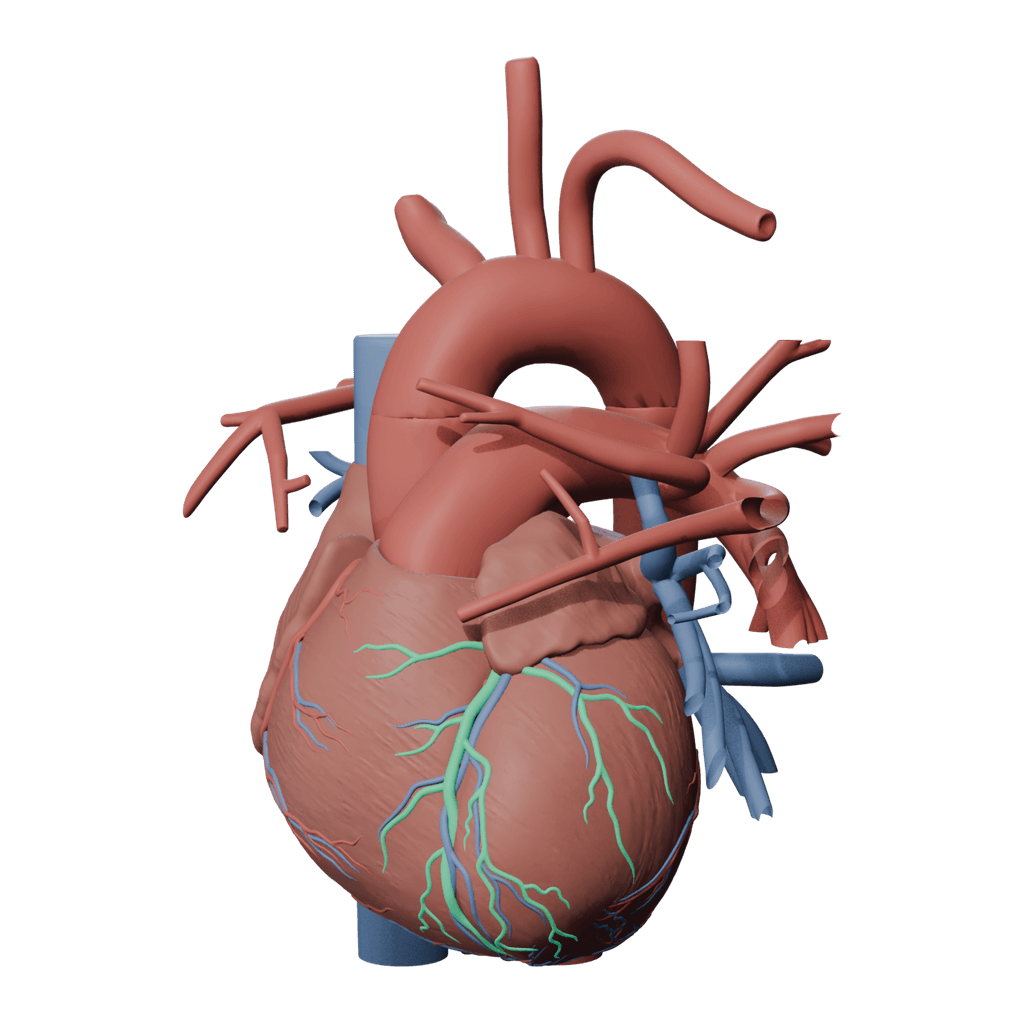
- Origin
- Left aortic sinus, just above the aortic valve
- Course
- Short left main trunk between the pulmonary trunk and the left auricle
- Divides into
- Left anterior descending artery and circumflex artery
- Circumflex branches
- Obtuse marginal arteries, atrial branches, sometimes the SA nodal artery
- Supplies
- Left atrium, most of the left ventricle, anterior septum (through the LAD)
The left coronary artery (LCA), often called the left main coronary artery, is a short but very important vessel. It leaves the aorta, runs for only a short distance and then splits into two large branches: the left anterior descending artery, which runs down the front of the heart, and the circumflex artery, which wraps around the left side to the back. Together they supply most of the left ventricle, the chamber that pumps blood to the whole body.
Origin and course of the left main
The LCA arises from the left aortic sinus, one of the bulges in the aortic wall just above the aortic valve. It passes to the left, behind the pulmonary trunk and in front of the left auricle (the small ear-shaped pouch of the left atrium). This first segment is short. At the left end of the coronary sulcus it divides.
In some hearts the left main splits into three instead of two. The extra middle branch, called the ramus intermedius, runs between the other two and supplies the lateral wall of the left ventricle.
The two main branches
- Left anterior descending artery (LAD, or anterior interventricular artery): runs down the anterior interventricular sulcus toward the apex. It is covered on its own page, the left anterior descending artery.
- Circumflex artery: turns left into the coronary sulcus and is described below.
The circumflex artery
The circumflex artery follows the left part of the coronary sulcus, the groove between the left atrium and the left ventricle. It curves around the rounded left border of the heart, the obtuse margin, onto the back of the heart. Along the way it gives:
- Obtuse marginal arteries: one or more branches that run down the obtuse margin and supply the lateral wall of the left ventricle. They are the circumflex's main branches and are often numbered OM1, OM2 and so on.
- Atrial branches to the left atrium.
- Sinoatrial (SA) nodal artery in a minority of people. In most hearts this branch comes from the right coronary artery instead.
How far the circumflex goes on the back depends on coronary dominance. In the common right-dominant heart it ends before the crux, the meeting point of the grooves at the back of the heart. In a left-dominant heart it continues to the crux and gives the posterior descending artery and usually the AV nodal artery. Then the whole left coronary system supplies the entire septum. The comparison is laid out on the right coronary artery page.
Territory
| Branch | Main territory |
|---|---|
| LAD | Anterior wall of the left ventricle, anterior two-thirds of the septum, apex |
| Circumflex | Left atrium, lateral and posterior wall of the left ventricle |
| Circumflex in a left-dominant heart | Also the inferior wall and the posterior septum |
Clinical relevance
- Left main disease: because the left main feeds both the LAD and the circumflex, a severe narrowing here puts a large part of the left ventricle at risk. It is treated as a high-risk finding and is often managed with bypass surgery.
- Circumflex occlusion: a blockage of the circumflex or an obtuse marginal branch causes a lateral wall infarction. The lateral and posterior walls are not seen directly by many standard ECG leads, so these infarcts can be harder to spot than anterior or inferior ones.
How to remember it
Think of the left main as a short trunk that forks almost at once: one branch goes straight down the front (LAD), the other goes around the side (circumflex). Down and around. The circumflex then drops its marginal branches over the obtuse margin like fingers over the edge of a table.
Quick self-check
- What are the two branches of the left main coronary artery? The left anterior descending artery and the circumflex artery.
- Which branches of the circumflex supply the lateral wall of the left ventricle? The obtuse marginal arteries.
- In a left-dominant heart, which artery gives the posterior descending artery? The circumflex artery.
Related
In the atlas
Sources
- Anatomy, Thorax, Heart Arteries · StatPearls (NCBI Bookshelf)
- Anatomy, Thorax, Heart Left Anterior Descending (LAD) Artery · StatPearls (NCBI Bookshelf)
- 19.1 Heart Anatomy · OpenStax, Anatomy and Physiology 2e
Written by the Femurize team for study purposes; not medical advice. Last updated 2026-11-16.