 Femurize
Frontal bone
The frontal bone forms the forehead and the roofs of the orbits. Its parts, landmarks, sinuses and articulations, with a quick self-check and a 3D quiz.
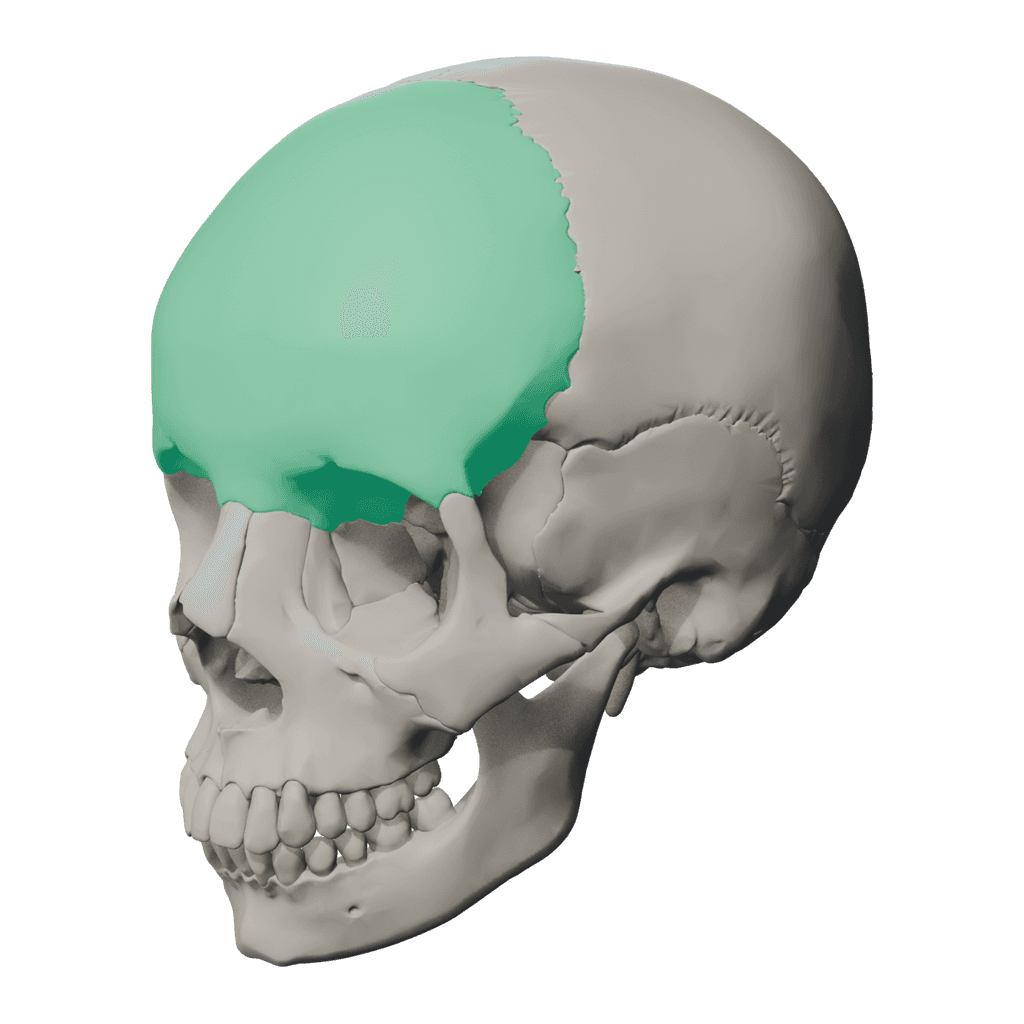
- Type
- Flat bone of the cranial vault, unpaired
- Location
- Forehead, front of the cranial vault, roofs of the orbits
- Parts
- Squamous part, orbital parts, nasal part
- Articulates with
- Parietals, sphenoid, ethmoid, nasals, maxillae, lacrimals, zygomatics
- Key landmarks
- Supraorbital margin and notch, glabella, frontal sinuses, zygomatic processes
The frontal bone forms the forehead and the front of the cranial vault. It then bends backwards to form the roof of each orbit and most of the floor of the anterior cranial fossa. It is a single bone in the adult, although it starts as two halves at birth.
Location and parts
The frontal bone sits at the front of the skull, above the orbits and the nose and in front of the two parietal bones. It is usually described in three parts:
- Squamous part: the large, curved vertical plate of the forehead.
- Orbital parts: two thin horizontal plates that form the roofs of the orbits and the floor of the anterior cranial fossa. Between them is a gap, the ethmoidal notch, filled by the cribriform plate of the ethmoid.
- Nasal part: a small midline area between the orbits that meets the nasal bones and the maxillae.
Landmarks to know
- Supraorbital margin: the upper rim of each orbit. Along it, a supraorbital notch or foramen carries the supraorbital nerve and vessels to the forehead.
- Superciliary arches: the ridges above each orbit, behind the eyebrows.
- Glabella: the smooth midline area between the superciliary arches, just above the nose.
- Zygomatic processes: the lateral ends of the supraorbital margins, which meet the zygomatic bones at the frontozygomatic suture.
- Frontal sinuses: two air spaces inside the bone behind the superciliary arches, usually unequal in size, that drain into the nasal cavity.
- Frontal crest and foramen cecum: on the inner surface, in the midline, where the falx cerebri attaches.
Articulations
The frontal bone meets the two parietal bones at the coronal suture. In the anterior cranial fossa it meets the ethmoid and the lesser wings of the sphenoid, and on the side of the skull it reaches the greater wing of the sphenoid at the pterion. In front and below, it meets the nasal bones, the frontal processes of the maxillae, the lacrimal bones and the zygomatic bones.
Development
At birth the frontal bone is in two halves separated by the metopic (frontal) suture. The halves usually fuse during the first years of life. In some adults a trace of the metopic suture persists, which can look like a fracture line on an X-ray. The anterior fontanelle, the soft spot of a newborn, sits where the two frontal halves meet the two parietal bones.
Clinical relevance
- Frontal sinusitis: infection of the frontal sinuses can cause pain above the eyes. Because the sinus sits right in front of the anterior cranial fossa, infections can rarely spread inwards.
- Fractures: the orbital plates are thin, so a blow to the brow can fracture the roof of the orbit, and fractures of the anterior cranial fossa can tear the meninges.
- Supraorbital nerve block: the supraorbital notch is a landmark for anesthetizing the forehead.
How to remember it
Think of the frontal bone as a helmet visor: a vertical plate in front, bent into two horizontal shelves over the eyes. If you can find the supraorbital notch and the coronal suture, you can place it on any view of the skull. It is the F in the cranial bone mnemonic PEST OF 6, explained in our guide to all 22 skull bones.
Quick self-check
- Which suture separates the frontal and parietal bones? The coronal suture.
- What passes through the supraorbital notch? The supraorbital nerve and vessels.
- Which bone fills the gap between the two orbital plates? The ethmoid, through its cribriform plate.
Related
In the atlas
Sources
- 7.2 The Skull · OpenStax, Anatomy and Physiology 2e
- Anatomy, Head and Neck, Skull · StatPearls (NCBI Bookshelf)
- Overview of the Bones of the Skull · TeachMeAnatomy
Written by the Femurize team for study purposes; not medical advice. Last updated 2026-11-16.