 Femurize
Bones of the Skull: All 22 Named, with Mnemonics
The 8 cranial and 14 facial bones of the skull, where each one sits, the sutures that join them, and two mnemonics that make the list stick for exams.
By Femurize · · 6 min read
In this article
The adult skull has 22 bones: 8 that form the cranium around the brain and 14 that build the face. Most anatomy courses expect you to name every one, find it on a skull from any angle, and know what it touches. This guide gives you the full list, a picture of where each bone sits, and two mnemonics that make the list easy to rebuild under exam pressure.
How many bones are in the skull?
The standard answer is 22. You will also see 28 or 29 in some books, and the difference is only in what gets counted:
- 22 counts the cranial and facial bones.
- 28 adds the six auditory ossicles (malleus, incus and stapes, three in each middle ear). They sit inside the temporal bones but are usually taught with the ear.
- 29 also adds the hyoid, which sits in the neck and does not touch any other bone.
If your course or exam does not say otherwise, 22 is the number to give. The mandible is the only one of the 22 that moves; the rest are locked together by sutures.
The 8 cranial bones
The cranium (neurocranium) is the bony box around the brain. It has a roof, the calvaria, and a floor, the cranial base. Four of its bones are single and two come in pairs.
| Bone | Number | Where it sits |
|---|---|---|
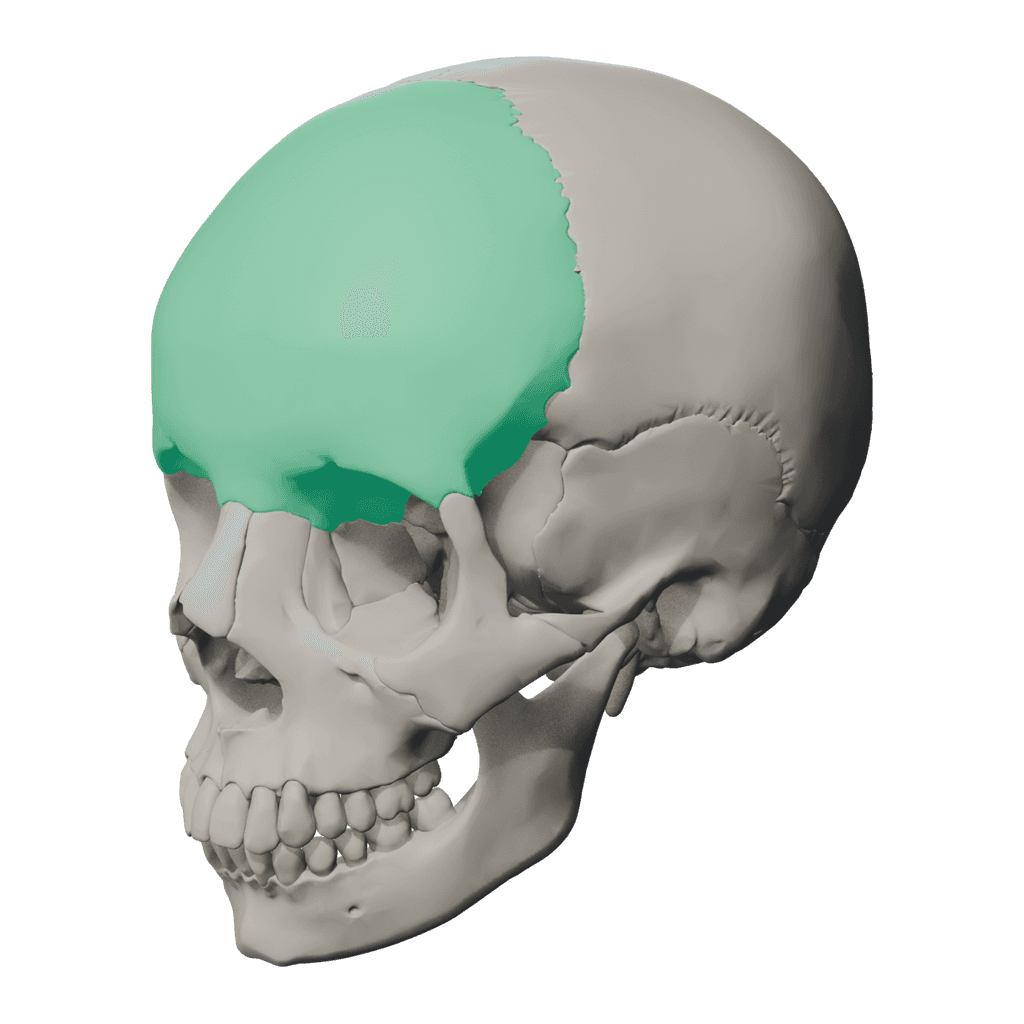
| Frontal | 1 | Forehead and the roofs of both orbits |
| Parietal | 2 | Most of the roof and upper sides |
| Temporal | 2 | Lower sides, around the ears |
| Occipital | 1 | Back and back of the base |
| Sphenoid | 1 | Middle of the base, wings reaching the sides |
| Ethmoid | 1 | Between the orbits, roof of the nasal cavity |
Frontal bone
The frontal bone forms the forehead and curves backwards to make the roof of each orbit. Above each orbit you can feel the supraorbital margin, with a small supraorbital notch or foramen for the nerve and vessels of the same name. The frontal sinuses sit inside it, just above the nose.
Parietal bones
The two parietal bones form most of the roof and upper sides of the cranium. They meet each other in the midline and have very few landmarks you need to know, which makes them easy marks on a practical.
Temporal bones
Each temporal bone sits below a parietal bone and contains the middle and inner ear. Learn four landmarks: the external acoustic meatus (the ear canal), the mastoid process behind it, the thin styloid process pointing down, and the zygomatic process that runs forward to join the zygomatic bone and form the cheekbone arch. The mandibular fossa on its underside is where the mandible hinges.
Occipital bone
The occipital bone makes the back of the head and much of the posterior cranial base. Its big opening, the foramen magnum, lets the brainstem continue as the spinal cord. On either side of it the occipital condyles sit on the atlas, the first cervical vertebra, which is why nodding happens here.
Sphenoid bone
The sphenoid sits in the middle of the cranial base and is often described as a bat or butterfly: a central body, two lesser wings, two greater wings and two pterygoid processes hanging down. On top of the body, the sella turcica holds the pituitary gland. It touches every other cranial bone, which is why it is called the keystone of the cranial floor. It has so many openings that it gets its own guide.
Ethmoid bone
The ethmoid is light, delicate and mostly hidden. Its cribriform plate, perforated like a sieve, lets the olfactory nerve fibres pass from the nose to the brain. The crista galli sticks up into the cranial cavity, and the perpendicular plate drops down to form the upper part of the nasal septum. Its side parts form much of the medial wall of each orbit and carry the superior and middle nasal conchae.
The 14 facial bones
The facial skeleton (viscerocranium) supports the face, holds the teeth, and frames the orbits and nasal cavity. Six bones come in pairs and two are single.
| Bone | Number | Where it sits |
|---|---|---|
| Nasal | 2 | Bridge of the nose |
| Maxilla | 2 | Upper jaw, most of the hard palate, floor of the orbit |
| Zygomatic | 2 | Cheekbones, outer wall of the orbit |
| Lacrimal | 2 | Front of the medial wall of the orbit |
| Palatine | 2 | Back of the hard palate |
| Inferior nasal concha | 2 | Lowest scroll on the side wall of the nasal cavity |
| Vomer | 1 | Lower and back part of the nasal septum |
| Mandible | 1 | Lower jaw |
The maxillae are the center of the face: every other facial bone except the mandible touches them. For landmarks and clinical notes on each one, see the guide to the facial bones.
Mnemonics for the skull bones
A mnemonic is only a hook for the list. Use it to check you have not forgotten a bone, then practice pointing to each one.
Cranial bones: PEST OF 6
PEST OF 6: Parietal, Ethmoid, Sphenoid, Temporal, Occipital, Frontal. The 6 is a reminder of the six auditory ossicles, which live inside the temporal bones.
Remember that parietal and temporal are the paired ones, and the six letters give you all eight bones. A second option, if you prefer a sentence: Old People From Texas Eat Spiders (Occipital, Parietal, Frontal, Temporal, Ethmoid, Sphenoid).
Facial bones: Virgil Can Not Make My Pet Zebra Laugh
Virgil Can Not Make My Pet Zebra Laugh: Vomer, Conchae (inferior nasal), Nasal, Maxilla, Mandible, Palatine, Zygomatic, Lacrimal.
That gives eight names. The two single bones are the vomer and the mandible; the other six are paired, which brings the total to 14.
The sutures that join them
Sutures are the fibrous joints between the skull bones. Four of them come up again and again:
- Coronal suture: between the frontal bone and the two parietal bones, running across the top of the head from side to side.
- Sagittal suture: between the two parietal bones, in the midline from front to back.
- Lambdoid suture: between the parietal bones and the occipital bone. Its shape looks like the Greek letter lambda.
- Squamous suture: between each parietal bone and the temporal bone below it.
Where the coronal and sagittal sutures meet is the bregma, the site of the anterior fontanelle in a newborn. Where the sagittal and lambdoid sutures meet is the lambda, the site of the posterior fontanelle.
The pterion
On the side of the skull, four bones meet in a small H-shaped area called the pterion: the frontal, the parietal, the squamous part of the temporal, and the greater wing of the sphenoid. The bone is thin here, and the anterior branch of the middle meningeal artery runs just inside it. A blow to the side of the head can fracture the pterion and tear the artery, causing an extradural (epidural) hematoma. That is why it shows up in almost every head and neck exam.
How to learn the skull bones fast
Reading this list is the easy part. The hard part, and the one that is tested, is looking at a skull from a new angle and producing the name from memory. Three habits make that happen:
- Group by region, not alphabet. Learn the vault (frontal, parietal, occipital, temporal), then the base (sphenoid, ethmoid), then the face. Lesson order matters less than learning bones next to their neighbours.
- Test yourself before you feel ready. Retrieval practice, trying to recall a name before you look it up, builds memory better than rereading. We explain the evidence in our guide to active recall for anatomy.
- Rotate the skull. The sphenoid looks completely different from the side, from below and from inside the cranial cavity. If you only learn one view, you only know one view.
Femurize turns those habits into a short loop. In the free cranial vault lesson, one bone lights up on a 3D skull and you type its name. The face lesson does the same for the facial bones, and the whole skull review shuffles all of them. Hidden bones like the ethmoid and vomer are shown with the rest of the skull turned translucent, so you can see where they actually sit.
Quick self-check
Cover the answers and try these:
- Which cranial bones are paired? Parietal and temporal.
- Which bone forms the upper part of the nasal septum? The ethmoid, through its perpendicular plate.
- Which four bones meet at the pterion? Frontal, parietal, temporal and sphenoid.
- Which skull bone moves? The mandible.
- How many facial bones are single? Two: the vomer and the mandible.
If you got all five, you are ready to name them on a rotating skull.
Sources
- 7.2 The Skull · OpenStax, Anatomy and Physiology 2e
- Anatomy, Head and Neck, Skull · StatPearls (NCBI Bookshelf)
- Anatomy, Sphenoid Bone · StatPearls (NCBI Bookshelf)
- Overview of the Bones of the Skull · TeachMeAnatomy
Written and reviewed by the Femurize team for study purposes. It is not medical advice.